Key points
- Cats scratch to mark their spot with scent from their paws and to shed the worn outer layer of their claws, the ASPCA and Cornell explain.
- Watch whether your cat scratches upright or on the floor, and match the scratcher to it.
- Put the scratcher next to the spot your cat already uses, and another near where it sleeps.
- Keep a worn, ragged scratcher: cats like a surface they can sink their claws into.
Why cats scratch
The Cornell Feline Health Center describes scratching as largely a marking behavior: glands in a cat’s paws leave scent wherever it scratches. The ASPCA adds that scratching removes the frayed, worn outer layer of the claws and exposes the sharper ones underneath, and Humane World for Animals notes that it is often just a good stretch.
That is why the ASPCA’s advice starts where it does. The best approach, it says, is not to stop a cat from scratching but to teach it where and what to scratch. A scratcher is not a punishment for the sofa. It is the place you would rather the cat chose.
Upright or flat: watch your cat first
Cornell suggests a simple test before you buy anything. Does your cat scratch vertically, with its paws stretched out above its head, or does it prefer horizontal surfaces? A cat that tears at the side of the sofa or a door frame is an upright scratcher. A cat that rakes the rug or the carpet on the stairs is a flat one.
Cat Friendly Homes, the site of the feline veterinarians formerly known as the AAFP, says most cats like to scratch vertically, and suggests trying a horizontal scratcher for a cat that scratches carpet. Cornell makes the same point about cardboard: a cat that likes the horizontal motion of raking a carpet may take to a flattened cardboard scratcher.
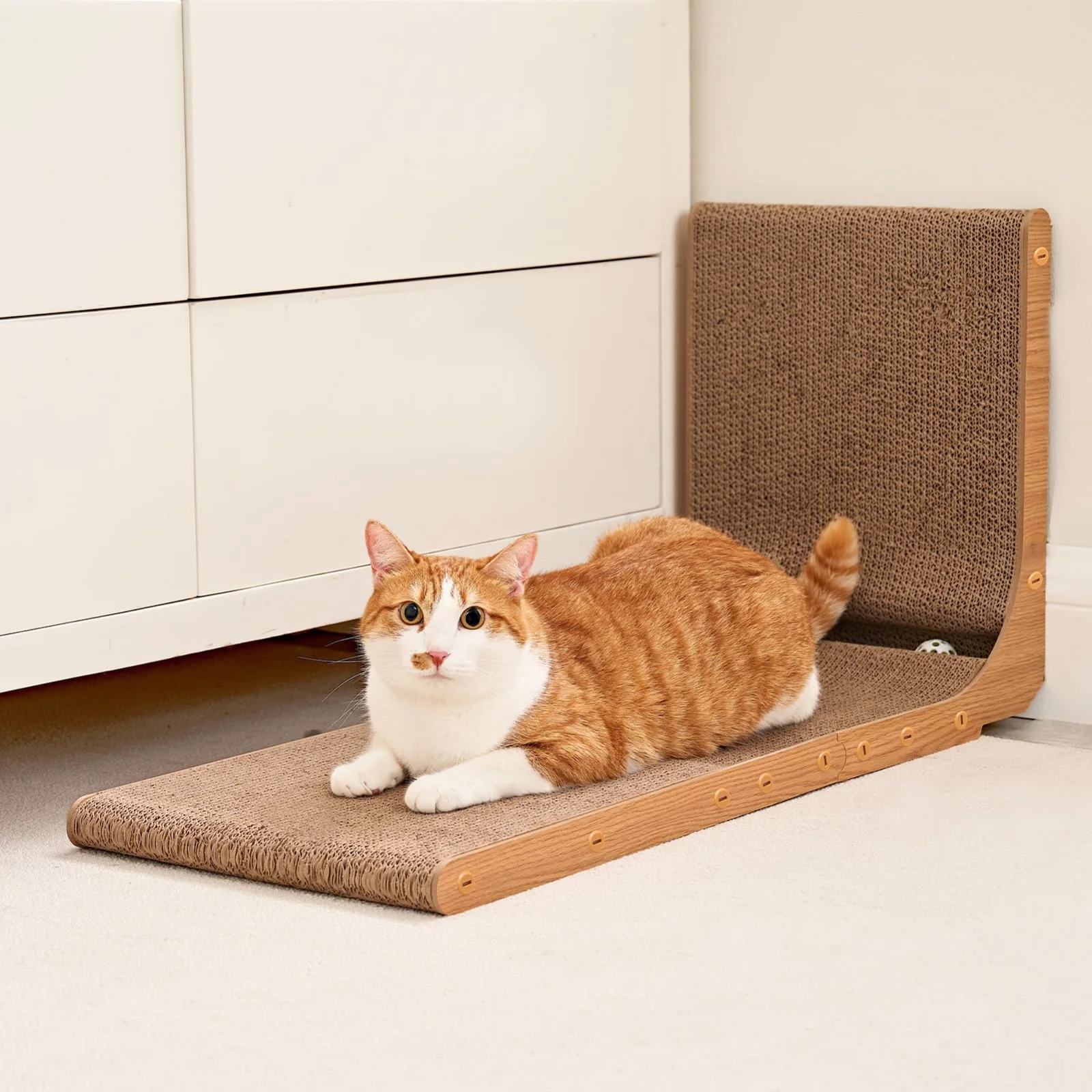
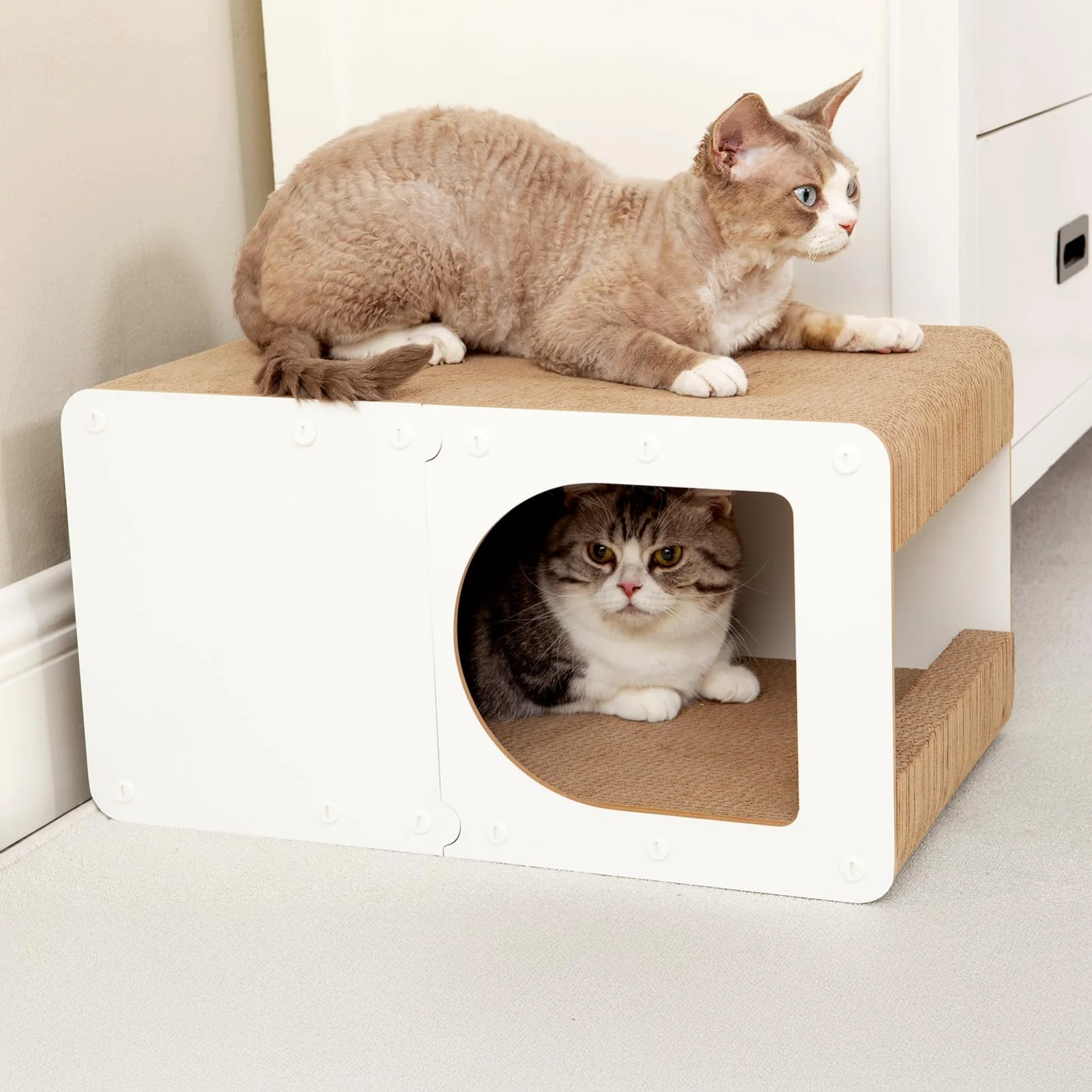
Our L-shaped scratcher covers both in one piece: an upright board meets a floor pad in a corner. The scratcher house and the lounge scratcher lie on the floor for the cats that rake.
| Your cat scratches | What to try | Why |
|---|---|---|
| The side of the sofa or a door frame | L-shaped scratcher or the 2-pack | An upright board in the corner it already uses |
| The rug or the stairs carpet | Scratcher house or the lounge | Flat cardboard to rake |
| Both, depending on the day | One upright, one flat | Two shapes in two places |
Where to put it
Location decides more than material. Cornell suggests placing the scratcher next to an area your cat already likes to scratch, and Humane World for Animals agrees: put it where the cat wants to scratch, not where it looks tidy. If that is the corner of the sofa, the scratcher goes in that corner, at least for the first weeks.
Cat Friendly Homes adds a second spot. Cats often stretch and scratch as soon as they wake, so place a scratcher near where your cat sleeps. In a house with two cats, or one cat with two favorite corners, that is the case for our 2-pack of corner scratchers.
Once your cat uses the new scratcher reliably, you can move it a little at a time toward a place you prefer.
Getting a cat to use it
Humane World for Animals warns against carrying a cat to the scratcher and rubbing its paws on it, which tends to put cats off. Play works better. Drag a toy across the cardboard, rub a little catnip into it, or drop a treat on top. Cat Friendly Homes suggests rewarding your cat right away, within a few seconds, when it scratches the right thing.
Our lounge scratcher comes with two teaser wands that stick onto the cardboard, and the L-shaped scratcher has a ball on a spring, both there to start that kind of game.
Steady on the floor, long enough for a stretch
The ASPCA says all cats want a sturdy scratching surface that will not shift or collapse when they use it. A flat cardboard scratcher that skates across a wooden floor at the first pull is one a cat soon gives up on. Set ours on a rug, against a wall or in the corner the cat already uses, where it has something to push against. The L-shaped scratcher stands on its own, with the floor pad holding the upright board in place.
Length matters for the same reason. Scratching is often a stretch as much as anything, as Humane World for Animals points out, so a cat should be able to reach out to its full length on the board. A big cat on a pad meant for a kitten gets a few short strokes and walks off. If you have a long cat, choose one of the larger sizes, or put two boards end to end.
Cornell describes scratching as marking: scent from the paws stays on the surface. The ASPCA adds that cats also scratch as a signal to other cats. In a house with more than one cat, each cat usually needs its own place to scratch, and a scratcher by a doorway or a favorite window may get more use than one tucked away in a spare room.
A ragged scratcher is a working scratcher
Do not throw a scratcher away because it looks worn. Cornell says so in as many words, and the ASPCA explains why: cats prefer shredded and torn surfaces because they can really get their claws into them. The crumbs of cardboard on the floor are a sign the scratcher is doing its job.
Corrugated cardboard does wear through in the end. The boards of our 2-pack can be taken apart and flipped, so the second face takes over when the first is worn, and the L-shaped scratcher comes in four sizes, the smallest of them for kittens.
What cardboard does and does not do
The ASPCA lists cardboard among the materials to try, along with carpeting, wood, sisal and upholstery, and notes that some cats prefer horizontal posts. Cardboard is a good first try for a cat that rakes, and an inexpensive one. A cat that wants to stretch to its full height on a tall post, as the ASPCA puts it, may want a tall sisal post too.
If your cat’s scratching damages its own claws or skin, or starts suddenly in a cat that never scratched before, ask your veterinarian. For the rest of the house, our cat scratchers sit on one shelf.
Every product named here is part of the EHEYCIGA lineup.